

My Achievements

Fundraising page

Updated Profile Pic

Added a Blog Post

Received 5 Donations

Received 10 Donations

Received 15 Donations

Received 20 Donations

Reached Goal

Increased Target
My Updates
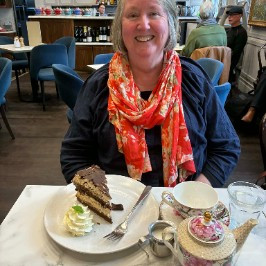
31 May – The Epic Grand Finale – Fortnum & Mason Earl Grey Tea
Sunday 31st May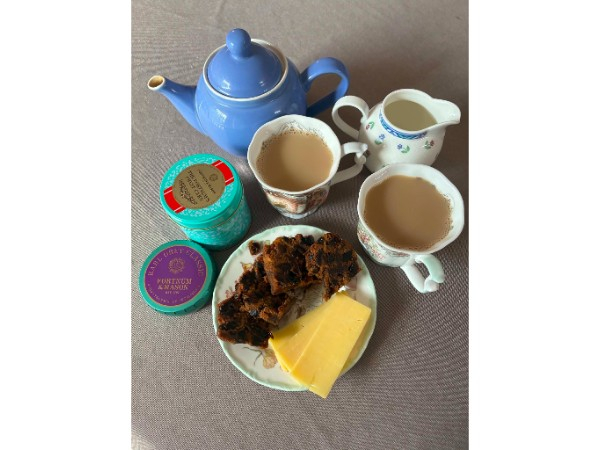
31 May – The Epic Grand Finale – Fortnum & Mason Earl Grey Tea
In came the Earl, right at the end. And he brought fruit cake with him. A Fortnum & Mason tea party to celebrate the end of this Ridiculously Good Challenge.
The Stats from this Ridiculously Good Tea Challenge
Teas reviewed: 53
Number of friends who provided tea for this challenge: nine
Controversies: Lipton and Bushells are the same company (these days – not originally!) Rooibos isn’t tea. The suggestion to have chamomile tea with milk. White tea was harmed in this challenge. Does one need a kettle which allows you to select the desired heating temperature? Meredith likes Russian Caravan tea. Thinly sliced cheese was photographed in proximity to the F&M fruitcake – IYKYK.
Words written: 13,738 – almost a thesis, except for the lack of references, the variable scientific rigour and the abundance of “cut and paste” from the interwebs.
Funds raised: $2874. Thank you so very much for your generosity. I cannot tell you how much I love being a YouthCARE chaplain, and your donations will help this organisation to continue to grow and flourish. If you would still like to make a donation, I believe the fundraising pages will remain open for a few more days.
Suggested spin offs: A book. A guided tea tour – so far we’re visiting Singapore and London and everyone’s welcome. A high tea where I give a talk on tea. That I take my tea talk on tour to high teas in other parts of Australia. A tea swap meet. A challenge for readers of these reviews to list out all the teas I tried and to try and rank them in the order you think I would rank them from most favourite to least favourite.
Level of joy and thankfulness: Huge. I have learned so much. It’s been enormous fun trying out all of these teas – not once this month did I wake up dreading having to go another round of tea and reviewing. So many wonderful interactions in person and on social media. So many great conversations that may not have otherwise taken place. A month of writing is a real treat – to write while drinking tea is one of life’s joys for me.
Today’s F&M tea experience: Ridiculously good!
Share
30 May – Epic Week - Day Six - Spring Green Tea and an Epic Surprise
Saturday 30th May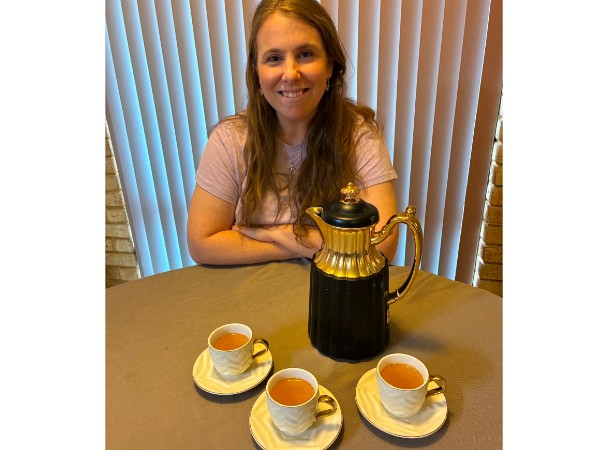
No one is more surprised than I am that I have returned to green tea!! Especially this late in this Ridiculously Good Challenge. Allison and I found ourselves sipping tea (or coffee) at one of our favourite cafés. My tea of choice was Spring Green Tea.
Ingredients: Pure Green Tea, Rose Petals, Cornflowers, Marigold Petals, Lemon Peel
Product description: A refined composition of pure green tea married with rose petals, cornflower blossoms, marigold petals and lemon peel. The infusion radiates floral brightness with a soft citrus lift, finishing smooth, clean and gentle on the palate.
Allure: Previous success with rose petals, the joy of cornflowers, the delight of citrus.
The danger: If the water is too hot…
The verdict: The water was too hot. No rose petals, cornflowers or citrus detected. A bitter disappointment. (That may be a tad strong. The tea was a tad strong.)
But this second last epic day was more than redeemed. This afternoon, just as Allison and I were discussing our next cup of tea, I received a text from Pamela who had just made a flask of Middle Eastern Karak Chai, and was on her way for a spontaneous tea party.
Karak Chai is made with black tea brewed in boiling water and mixed with cardamom and cloves that have been steeped in warmed evaporated milk. There is a variety of steps with mixing, heating, cooling, heating again – the whole process takes about 15 minutes to do – and the tea is served hot. Pamela lived in the Middle East for a bit and although not native to the area, was renown for her Karak.
Pamela has been talking about Karak and other Middle Eastern tea delights throughout this Ridiculously Good Tea Challenge, and I was so very pleased to have dear Pamela and her special tea sneak into the line up right at the end, especially given this morning was a bit of a flop.
The Karak – it is sweet and milky which, on paper, would not be my preferred tea profile however I went into today’s tasting knowing this would be the case. The first flavour is sweetness. Then you taste the cardamom and the final flavour on your palate is the cloves, which is warming and comforting. I loved drinking this, most especially because it came to the table and this epic week with great love.
Share
29 May – Epic Week - Day Five - Blossoming Tea
Friday 29th May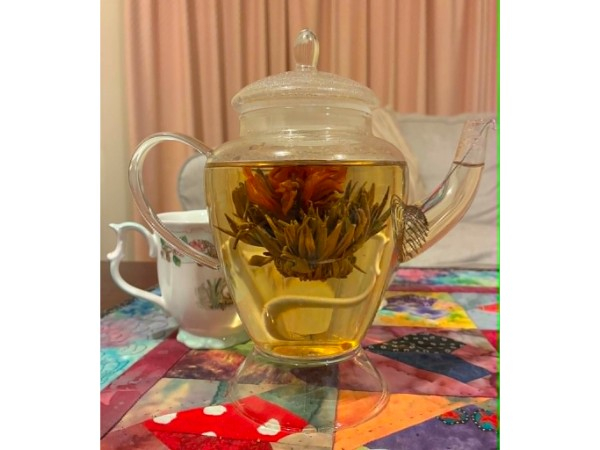
Today’s was a very special cup of tea. Last week I received a gift in the mail from the CEO of YouthCARE – a package with two balls of blossoming tea. One is black tea with peony, the other is white tea with lily and globe amaranth.
Blossoming tea comes as a dried flower tightly and ingeniously wrapped in Camellia sinensis leaves. When these tightly bound little balls of tea meet an appropriate amount of freshly drawn, hot (appropriate temperature to the style of the tea) water they unfurl and a beautiful flower blooms right there in your teapot!
Tamsyn set the pace for this Ridiculously Good Challenge. She set out to clock up 638 minutes in an ice bath during the 31 days of May – one minute for every school and sporting community supported by YouthCARE. 638 minutes in an ice bath or 31 days of drinking tea. Said I, “That’s why you’re the CEO and I’m a two day a week chaplain!” She’s nearly done it. She’s amazing. And she sent me some blossoming tea. She’s amazing and kind.
I saved these blossoming teas for today because today marks the last school day of this challenge. I toyed with having one of these blossoming teas at school, but this is not a quick teabag in a mug of water situation. They take time to blossom, they need to be treated in a dignified way, and the life of a chaplain can be very unpredictable. It would have been a sad thing to get a tea ball all up and blossoming, only to be called away to attend to someone.
Also, my dear friend Allison from Adelaide flew into Perth today for a weeklong visit. That’s worthy of a special celebration. She is a coffee connoisseur, but today she was introduced to blossoming tea!
In preparation for today’s tea adventure, I emailed teas.com where these little balls of tea wonder came from for instructions, having dealt white tea a significant and bitter blow earlier on in the challenge. For the white tea ball one needs 70 to 80 degrees. Boiling water will be okay for the black tea ball.
Given the time of night we set off on this tea adventure, we opted for the white tea with lily and globe amaranth for a lower dose of caffeine.
I’m reasonably sure I was close to 75 degrees with some measuring and mathematics, and reasoned that a few less degrees than 80 would hopefully counteract the longer steeping time than would be usual for a white tea to allow for the flower arrangement to bloom fully.
The end result was a fun floral display in the teapot and a pale, pleasant tea in the Brambly Hedge cups. The flowers were the visual feast but didn’t really impact the flavour of the tea. The tea was a properly brewed white tea. Allison picked up a citrusy aroma when the water first hit the tea ball and toffee notes in the tasting. No bitterness in this cup of a tea. An epic finish to the school week.
Share
28 May – Epic Week - Day Four - Meredith’s Tea Party at School
Thursday 28th May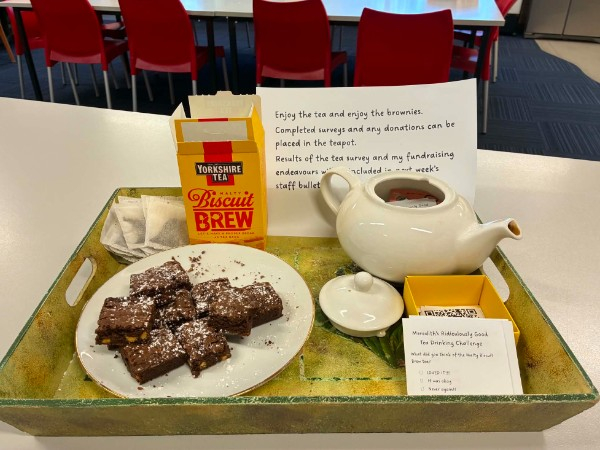
Yesterday was tea flavoured biscuits. Today is biscuit flavoured teas.
I started the day with an M&S (Marks & Spencer) Shortbread tea. “Known officially as the M&S Luxury Gold Shortbread Flavoured Tea, it blends their popular Luxury Gold black tea with rich, buttery, shortbread-like notes—giving you the flavour of dunking a biscuit into your tea, without the crumbs.” So says the internet. I could definitely taste the shortbread, but I’d have greater enjoyment drinking this tea later in the day. Tea and biscuits at breakfast time isn’t ideal. Well, not for me.
But the big star of the day was Yorkshire Blend Biscuit Tea. I haven’t mentioned the Yorkshire Blend teas. They do a top shelf English Breakfast tea and they used to do a very good decaf EB as well. It was here that I started my decaf tea drinking journey, thinking that if anyone could make decaf tea be okay it would be this brand, and they did. They sell loose leaf tea as well. I gave my sister and brother-in-law a teapot and a box of Yorkshire Gold tea leaves as a wedding present back in the day. If you’re prepared to give it as a wedding present it must be good.
Today I set up my tea party in the staffroom. There were brownies, a box of Yorkshire Blend Biscuit Tea for the staff to try, a feedback sheet to rate the tea, a teapot in which to leave the feedback sheets and donations and a QR code (because teachers are very up with their tech!) in case anyone wanted to make an electronic donation.
Of those who responded:
I loved it - 9
It was okay - 2
Never again - 0
I only drink coffee – 0
I don’t drink tea or coffee - 3
My thoughts: I love my school and I love the staff. We have all been on a journey this week and this was a lovely moment of quiet joy. Shout out to the teacher who learned how to make a cup of tea and enjoyed drinking it. Shout out to Polly – the good provider of tea. And shout out to Yorkshire Blend Biscuit Tea – an excellent cup of tea had with excellent colleagues.
Share
27 May – Epic Week - Day Three - French Earl Grey and Some Special Cookies
Wednesday 27th May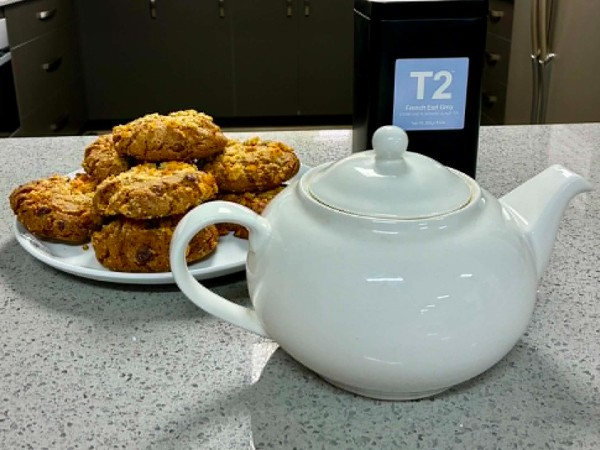
A couple of weeks ago, while the tea plans were still forming, Amy sent me a recipe for “White Chocolate and Earl Grey Tea and Toast Cookies”. You may have been wondering when the Earl was going to make an appearance. Not today, but today I brought out his French cousin, because while I was reading the cookie recipe I remembered that I hadn’t included French Earl Grey in the line-up. That would have been a serious omission.
We’ll get to the French Earl Grey in a moment, but first, these cookies. Let me say these are, in Amy’s words, “a bit of faff”. They’re certainly not as straight forward as the Women’s Weekly Chocolate Chip Cookies that you mix in a bowl, shape and throw into the oven. The ingredient list for these biscuits included hot buttered sourdough toast blitzed into very delicious breadcrumbs, ground up Earl Grey tea and a rather large amount of butter, various sugars and white chocolate. The WCAEGTAT cookies do not get the Heart Foundation Tick of Approval!
But this the last epic week of this Ridiculously Good Challenge so the cookies were made and my Wednesday Bible study group were the lucky recipients. Along with these biscuits I brought my teapot and the French Earl Grey tea leaves over to the church hall and we had quite the morning. The cookies were huge. I followed the recipe to the tee which meant 90 grams of cookie dough per biscuit. And they were delicious. You could taste the buttered toast and the white chocolate, but interestingly the dominant flavour was orange because…
…Earl Grey tea is black tea flavoured with bergamot. I thought bergamot was a herb, but it turns out it’s a citrus fruit that’s shaped like a pear, the size of an orange and the colour of a lemon, native to the sunny regions of southern Italy, particularly Calabria. The pulp is highly acidic but the zest and/or oil extracted from the skin is where we find the flavour.
French Earl Grey, or at least T2’s rendering of it, has the black tea and bergamot, and then apparently the addition of hibiscus, rose petals, sunflower petals, flavouring and mallow flowers renders it French. Some versions of French Earl Grey also have lavender, which seems more French than the other ingredients. I have a more than a hunch that the “flavouring” is vanilla.
This a great tea but it’s important, I think, not to make it too strong. Teas work so much better when you follow the instructions!! I don’t like drinking this one all the time, but if the time is right it’s a fabulous and elegant beverage. I followed the instructions and today’s brew was lovely.
Keep your eyes peeled – the Earl himself is coming soon.
Share
26 May – Epic Week - Day Two - Kalahari A Taste of Africa
Tuesday 26th May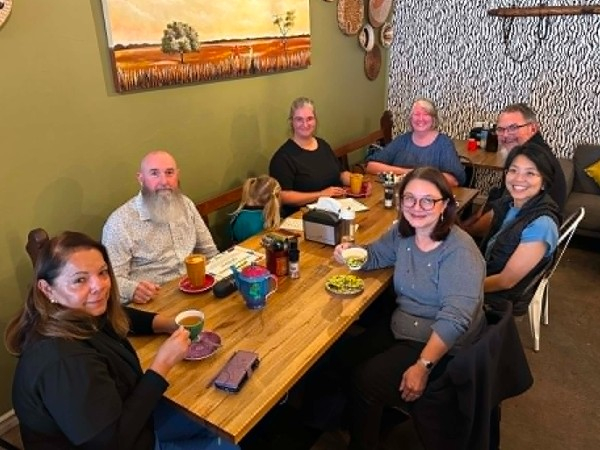
This Ridiculously Good Challenge is of course all about YouthCARE and the “C” in the CARE stands for Chaplaincy. Each school chaplain is placed in a small group of chaplains – a network group, if you like – who are all serving in adjacent suburbs and neighbouring schools. These are called Pastoral Support Groups. We meet once a term to share stories, collect wisdom from the assembled brains trust, get clarification on operational matters, and to pray for one another.
Each PSG has a chaplain who is the team leader, and my PSG has me as their leader. Needless to say, when I am convening our once per term meeting it’s usually couched in terms of catching up for a cup of tea. We met today. We always meet at Kalahari A Taste of Africa – a café and shop featuring all things South African. It has lovely long tables, a really interesting menu of hot and cold drinks and there are usually some nice eats in the cake fridge if anyone needs a snack.
Despite my invitation to catch up for a cup of tea, usually I am the only one who drinks tea. But today, bless them, they all ordered tea. I love them. We had two Earl Greys, two peppermints, two rooibos lattes and I chose a tea called Five Roses. I had done some prior research so was not surprised when I wasn’t presented with a teapot with five different sets of rose petals floating in hot water. Five Roses is a century old South African tea brand known particularly for its signature, smooth Ceylon black tea. I had a very fabulous pot for one and a small jug of milk on the side, and as you would by now know, had my very nice black tea with a dash of milk.
On International Tea Day Polly sent me a post all about tea and it said, in very plain terms, tea first and milk second, so that you have more control over the strength and colour of the tea. As previously discussed, I have always favoured the milk first and tea second method, handed down to me by my very lovely (and exacting when it came to matters of tea) parents.
The origins of putting milk in first actually hail back to the days when the art of making porcelain teacups was being perfected. Back then, centuries ago, you had to put some milk in first to temper the heat of the scalding hot tea otherwise the porcelain would crack and there would be no tea to drink. These days porcelain technology is all good, but I still favour the milk first option for teapot tea.
Today’s cup was very nice. I have to say, after nearly two weeks of drinking mainly herbal and green teas, it’s a bit of a relief to be back to black tea.
Share
25 May – Epic Week - Day One - Chai at Liesl’s Teahouse
Monday 25th May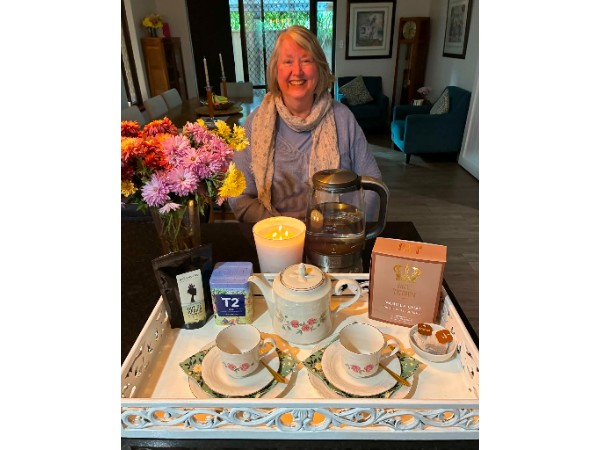
Today it was back to enjoy Liesl’s generous hospitality (she had me back even though I said that rooibos technically isn’t a tea!) for her favourite tea beverage – chai. It was an absolute treat.
Chai is enjoyed in many countries, but what we find in cafés and on supermarket shelves here in Australia by and large has its origins in India.
Classical chai masala (masala means “a blend of spices”) is made in a three-step process. Black tea is brewed in boiling hot water. Meanwhile your spices such as cardamom, cinnamon and cloves are infused in warm (but not boiling) milk. When ready, both are strained and combined, and then “pulled” or poured back and forth between two containers to aerate the beverage. Add honey as desired.
Apparently no two chais are ever the same. The choice of spices, the quantity of spices, the age of the spices…it all plays a part in the flavour. You know how every time you open a new jar of chilli flakes you have to test them for heat – with one jar you need to use a whole teaspoon while the next jar will have the same effect with a tiny pinch? And of course you know how that 2006 jar of dried thyme in your pantry is fairly devoid of flavour? These are some of the principles at work, alongside water temperature, brewing time and no doubt various other variables.
Non-classical chai is found boxes of loose-leaf tea with spices added, or in teabags. If you’re being uber fancy you can make your chai by infusing your leave tea + spices in simmering milk and if you’re not being quite so fancy you can use the usual tea making method with boiling water followed by a dash of milk. And then there is chai flavoured syrup added to frothed, warmed milk. Apparently that’s not great, but I don’t know anything about that.
Today we sampled four different chai teas using the boiling water followed by a dash of milk method, adhering to correct water temperature and brewing time.
T2 Loose Leaf Chai: Ingredients - Black tea, cloves, cardamom, cinnamon, flavouring, ginger, star anise
This was excellent. We peaked early. We saw cloves in the tea strainer so that’s evidence that the real spices were in that tin with the tea leaves. Beautiful aroma and beautiful flavour. The last flavour on the palate was a nice, warming ginger. This would be a very nice winter cup.
Seven Seas Margaret River Loose Leaf Tea – Out of Africa Rooibos Chai: Ingredients – Rooibos, ginger, cardamom, cinnamon, liquorice root, cloves, fennel, pepper, star anise, coriander seed, bay leaf
This was experimental in that it was badly out of date. Therefore, because we are all increasingly expert in all of this, the flavours were flattened. Worth noting though, it was a rooibos base which is milder than a black tea base. Despite its age it was still nice to drink and had more savoury notes than the T2 because of the more savoury spices involved. It would have been a very nice brew if it wasn’t “Best before 2022”. You can’t say we weren’t committed!
Then…Queen Victoria Vanilla Chai in a teabag (ingredients – black tea, cinnamon, natural vanilla flavour, cloves, cardamom) Vs Twinings Vanilla Chai in a teabag (ingredients – black tea, cinnamon bark, ginger, flavouring)
The QV tea gave a strong hit of vanilla aroma as soon as the boiling water landed on the teabag. After that it all flattened out. Not much vanilla, not much sense that it was a chai, didn’t quite hit the mark in terms of being a black tea even. That was a bit sad because the box it came in was very impressive.
The Twinings had a mild vanilla aroma and I could pick the vanilla and chai flavours, although I have to say that if I was doing a blind taste test I would possibly have missed the chai aspect. It was there but only because I knew it was there.
My apologies to those whose T2 shopping lists are growing but I think their loose-leaf chai is worthy of consideration.
Share
24 May – F&M Green Tea with Mandarin
Sunday 24th May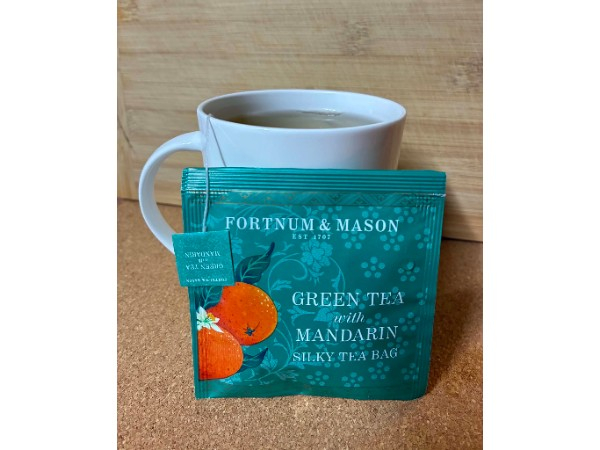
Today is my last green tea day in this series. It’s a good thing that I have spent the week mastering green tea making because today’s Grand Finale features my second last Fortnum & Mason teabag for this Ridiculously Good Challenge. It would be a travesty to ruin a F&M tea!
Back on 1st May I declared that I’d had some of the best tea ever when we were visiting England ten years ago. On the 3rd May I said there was another F&M story.
You see, the best cup of tea I have ever had was a F&M tea served by Khim and Eugenie at a Bible study group one evening back in the late 1990’s. It was brewed in a proper porcelain teapot and served in a proper porcelain teacup. From memory the cup was wide, shallow and very dainty. The tea was a light golden-brown colour. I took my first sip and all the world paused. I took another sip, looked at my smiling hosts, drifted comfortably back into their very comfortable sofa with tea in hand and thought I had died and gone to heaven. The tea? Champagne and elderflower tea. I’m not sure what the base tea would have been – possibly a green or a white tea - and just like higher end jasmine tea, it will have been patiently infused with the flavours of elderflowers and champagne.
Today, not elderflowers and champagne, but green tea with mandarin, and I have been quite looking forward to this! How could it not be good with such sweet packaging! Not my best photo because I have learned that lesson too…there isn’t time to muck around with photos when green tea is involved. Green tea waits for no one.
So I followed the instructions to the letter and have enjoyed a very beautiful cup of tea. No harshness or bitterness. And like the previous F&M teas, it isn’t two distinct flavours of green tea and mandarin. It’s one beautiful, melded cup of greenteaandmandarin. Very soft on the palate. Some of it comes down to making it properly and treating the tea with the gentleness it deserves. Some of it, I suspect, comes down to the quality of the ingredients and the care with which they have been processed, because F&M has a mighty fine reputation to uphold. They do, after all, hold Royal Warrants of Appointment, which means they are an official vendor to the royal household.
Tomorrow we launch into the final week of this Ridiculously Good Challenge. There are seven epic tea events scheduled. It’s going to be sensational. If you were thinking of making a donation towards the epic work of YouthCARE through my fundraising page, this would be the ideal week to do it, but please, only if you have capacity. Otherwise, sit back and get ready for some epic cups of tea.
Share
23 May – Soursop Green Tea
Saturday 23rd May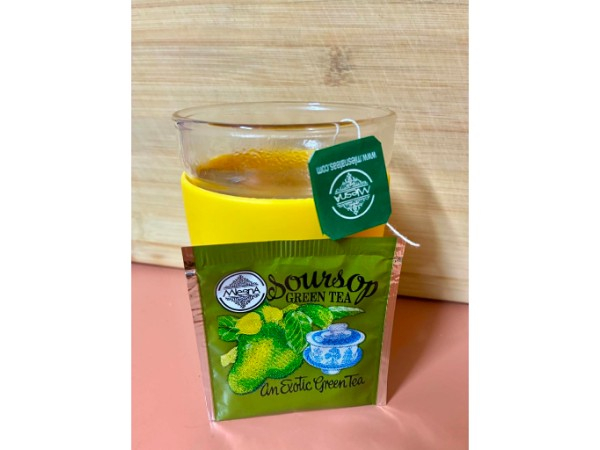
Things I am learning about green tea..
The cooler water temperature is vital. So is observing the prescribed infusing time. At the two or three minute mark a green tea can taste very nice. If you leave the teabag in longer than this because you are faffing about trying to take its photo, it turns on you and becomes bitter. It’s quite temperamental.
I am also learning that I prefer green tea that is flavoured with something else. Today I tried an English Tea Shop green tea with pomegranate. Pumping Pomegranate meets Green. It was okay. It was giving off medicine vibes – tasted a bit like children’s liquid Panadol. I’ll just stick with Pumping Pomegranate.
But the star of today was Soursop Green Tea! I was given a soursop green tea teabag at the beginning of this Ridiculously Good Challenge, and when I saw the word “soursop” my mind went to buttercups, otherwise known as oxalis or sour grass. Green tea with sour grass was not commending itself to me as a winning combination.
But Sue assured me it was lovely. Interestingly, Sue and two others have mentioned this very tea. All have mentioned that they sourced it from the now closed, very delightful Good Store in Victoria Park. All said the tea came in a lovely wooden box. All used the words “pleasant”, “sweet tasting”, “gentle” and the like. Really?
A little further research indicated that the other word for this buttercup weed/plant is soursob. Not soursop. The soursop is a tropical fruit, very similar in taste to a mango with a hint of citrus aroma. Okay, now I am listening. It’s made with high grown Ceylon green tea flavoured with natural soursop extracts.
I should have trusted Sue. She understands my taste in tea and also that I am fan of citrusy things. I used cooler water and whipped that teabag out of the cup at the two-minute mark. It was really, REALLY delightful. It’s not readily available in supermarkets but Mlensa tea can be sourced online. I can’t say this about many green teas, but this is one I would possibly go out of my way to have. Citrusy, and no buttercup notes!
Thank you Sue for this tea, and also for providing me with the Russian Caravan tea and I think one of two Packs a Peach teabags as well – an eclectic and winning set of teabag gifts.
Share
22 May – Jasmine Teas
Friday 22nd May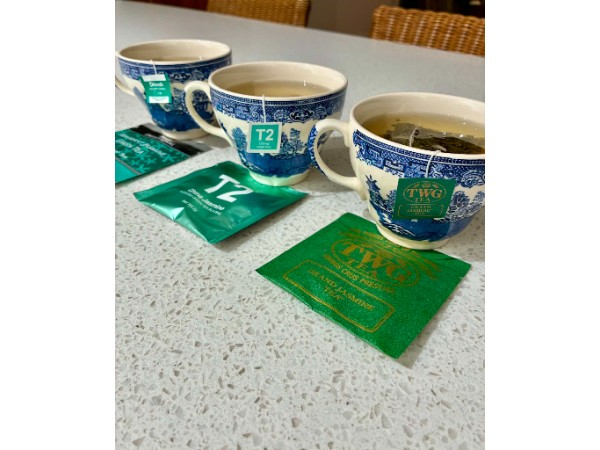
Hands up if you have ever had a pot of jasmine tea at a Chinese restaurant? Where does jasmine tea fit into our tea categories? Well, it turns out that jasmine tea is not a separate species of tea. It’s a scented green tea. It can be made from the other categories of our Big Six Camellia sinensis teas but it usually has green tea as its base.
High end jasmine tea is green tea that has been patiently infused with the aroma of fresh jasmine blooms – mixed in and then removed to be replaced with new, fresh blooms several times over. Lower end jasmine tea is green tea mixed with jasmine flowers and/or jasmine flavouring, which according to the experts makes the scent louder but the flavour flatter.
Hello there! That is a STOP PRESS moment. I have often observed that different herbal/fruity teas/tisanes have amazing aromas but not much flavour. When a tea has such a strong aroma I expect the flavour to be similarly punchy, and it’s always a surprise when it’s not. Now we know what’s going on there!!
So, three identical cups – not warmed. Freshly drawn and boiled water. Water then allowed to cool. All three jasmine teas have a brewing time of two to three minutes. One of them said 100 degrees, one 95 degrees and one 80 degrees (and it’s not necessarily the one you might think that decided 80 degrees would be the way to go), but we have learned our lesson. We know that anything more than 80 degrees is going to come to a bitter end.
Cup on the left – Dilmah Exceptional Fragrant Jasmine Green Tea – green tea with jasmine petals
Cup in the middle – T2 China Jasmine – green tea with jasmine
Cup on the right – TWG Grand Jasmine Tea – green tea blended with superior jasmine blossoms.
All three were gentle, elegant, pleasant cups of tea, and the difference between them was almost imperceptible. The Dilmah had the (ever so slightly) stronger jasmine aroma. The T2 had the (ever so slightly) stronger jasmine flavour and the TWG was (ever so slightly) smoother on the palate. I made my way almost to the bottom of each cup just working that much out. I would happily have any of them accompanying my meal at a Chinese restaurant. Not sure I will be sleeping tonight though…that’s quite a lot of caffeine for one evening!
Share
21 May – Twinning (not Twinings)
Thursday 21st May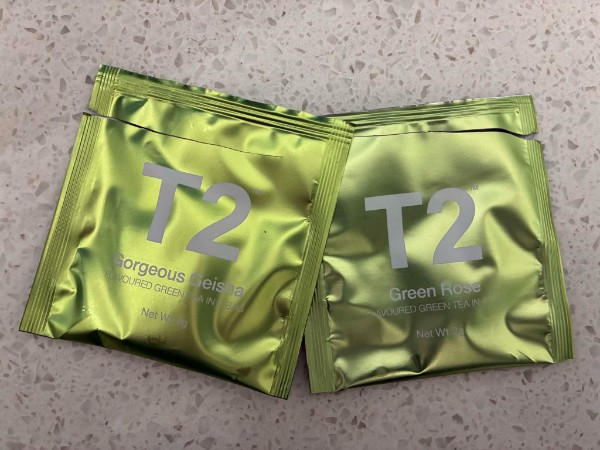
It's a school day. There's a set of twins at my school and I saw T1 last year for a bit. This year their mum asked me to see T2 (twin 2, not the tea shop...although more on that particular tea shop in a minute). T2 was very reluctant but his mum shared with me this snippet of conversation between the boys saying, "T1 has highly recommended Meredith, and told T2, 'She's just really fun, don't worry about it!'" T2 and I had three excellent games of Uno today. I lost all three of them. You know you’re a chaplain when you play twelve games of Uno in a day and lose eleven of them!
But today I am winning at green tea. Today it’s T2's turn. Twin greens from T2 - Gorgeous Geisha and Green Rose.
T2 Gorgeous Geisha
Ingredients: Green tea, flavouring 4% strawberry, yoghurt, cream, freeze dried strawberries
Aroma: I could smell the grass and I could smell the strawberries.
Colour: Pleasantly pale – tending more towards the brown than the green.
Flavour: Mainly grassy, but not overly bitter like yesterday. Water straight from the urn – probably not boiling – and I let it sit for a bit before adding the teabag. I was slightly disappointed because I was expecting more strawberry.
But…T2 Green Rose
Ingredients: Green tea 87%, currants, anti-caking agent sunflower oil, papaya bits, sugar, rose petals 2%, mango bits, sugar, acidifier 330, flavouring, cornflower petals.
Our old friend acidifier 330 is back in town. Anti-caking agent sunflower oil is sounding problematic. The rest is excellent.
Aroma: I could smell a rose garden – and not too overpowering. It was beautiful. All the fragrance without the hay fever.
Colour: Pleasantly pale – tending more towards the green than the brown.
Flavour: I could tell that the green tea was the carrier, but it was pleasantly fruity. I am getting the hang of the 80-degree water thing.
Green Rose wins! This is my favourite green tea so far. Smells of roses, tastes of mango. Winning all round.
Also happy International Tea Day!! In 2019 the General Assembly of the United Nations declared 21st May to be International Tea Day. Who knew? Not me, otherwise I may have paused the green teas to move an exciting event planned for next Thursday over to today to mark the occasion. Speaking of not marking the occasion, I didn’t even remember to take a photo of today’s teas, so all that I had this evening were two forlorn looking, empty packets. But hooray for T2 Green Rose.
Share
20 May - Have Your Greens!
Wednesday 20th May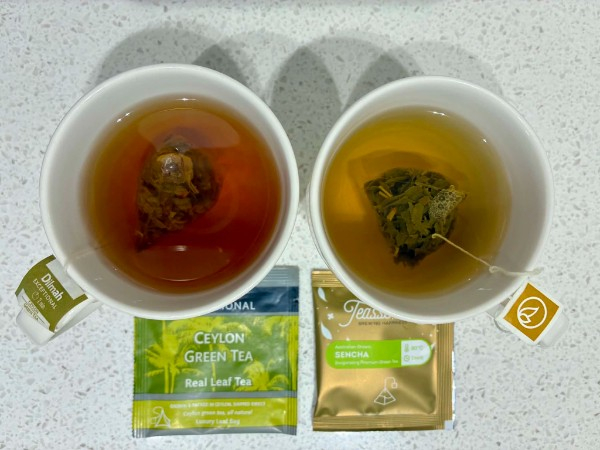
For the next few days we’re entering our green tea era. Let it be known that I am a green tea novice.
Green tea is processed by withering the freshly plucked leaves which are then steamed or pan-fried. The oxidisation process is halted early on to keep the leaves green, which gives it a light, fresh flavour. China produces lots of green tea, each region boasting its own flavour and aroma. Japan produces mainly green teas, generally known as sencha, which are steamed rather than pan-fried. Matcha is also Japanese – a green tea that is ground and included in the tea. You ingest the ground tea rather than having it strained out. I have had matcha a couple of times and I don’t really like it, so heads up, matcha won’t be making an appearance here.
Here is today’s journey. It was to be a research project on detecting the difference between green tea and sencha. Or so I thought.
Two identical, warmed cups.
Cup on the left – Dilmah Exceptional Ceylon Green Tea, 100-degree water, two minutes of brewing time.
Colour – tending towards the browner hues. Aroma – slightly floral. Flavour – delicate but a bitter, grassy aftertaste.
Cup on the right – Teassential Australian Grown Sencha, 80-degree water, two minutes of brewing time.
Colour – tending towards the greener hues. Aroma – grassy. Flavour – grassy up front but it didn’t leave a bitter aftertaste.
Both – not especially pleasant.
Change of direction in this research project.
The Twinings website stated, “We couldn’t imagine a world without green tea.” Well, sorry Twinings, but I could. This however did not seem right, so I did a bit of looking around the tea websites that seem to come up automatically these days.
I learned that green teas that steep too long or in water that is too hot can turn bitter almost immediately. Conversely, water that is too cold results in weak tea with little flavour. Another site “helpfully” said the best way to infuse green tea is to use a kettle with a built-in temperature control. (I could feel my interest in green tea rapidly diminishing at this point.) Twinings offered a helpful corrective of suggesting putting 20% cold water in your cup and then adding boiling for water for the remaining 80%, or if not feeling mathematically inclined, turning the kettle off just before it boils and letting it sit for a bit.
I found a Twinings Green Tea sample amongst the stash. Instructions – 95 degrees water (what???) and steep for two minutes. I went for something closer to 80 degrees (I do not have a kettle with built-in temperature control) and two minutes of brewing time.
Colour – tending towards the browner hues. Aroma – I couldn’t pick it, and not for want of trying. Flavour – mild, slightly floral/fruity, pleasant and no bitter aftertaste. Says Twinings of its own green tea – smooth, delicate, subtly sweet. I would agree.
This was a very uncontrolled science experiment – too many variables and things pretty much out of control – but essentially speaking, I ruined the first two cups of green tea. This then is not a poor review of those teas but rather a poor performance with my green tea making.
I have read that green tea is full of antioxidants, has myriad health benefits and is excellent for hydration. Having downed three cups of green tea, and also a cup of kitchen standard black tea as the sun was coming up, all before 10am, I shall be brimming with health for the day and well hydrated for the foreseeable future.
And given this only day one of the green teas, I shall need to make sure I follow the instructions. It seems we have a temperamental beverage on our hands.
Share
19 May – Black Tea and White Tea
Tuesday 19th May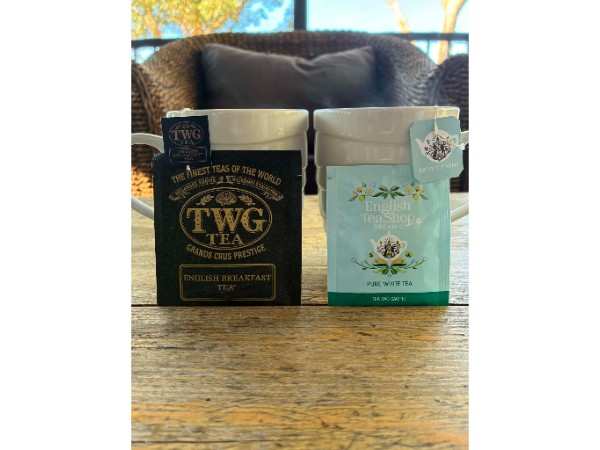
Apparently there six major categories of tea from the Camellia sinensis plant. All from the same plant but picked and processed differently to achieve different results. Here they are in order of oxidisation: Green (0%), White (0-5%), Yellow (10-20%), Oolong (15-80%), Black (80-100%) and Pu-erh (varies through to post-fermented). Anyone else wondering what happens between 5 and 10%???
What is oxidisation, you ask? It happens when the picked leaves are bruised and the exposed juices react with the oxygen in the air – just as happens when you cut an apple or avocado and leave them exposed to the air.
The other question you might ask, and indeed some HAVE asked, is where am I getting all this tea from? At the beginning of May I discovered I had more tea in my pantry than I realised, and that was after a recent clean out! Then there was the raid on Polly’s stash. I asked two friends for samples of teas they had mentioned. And the rest has come via unexpected, beautiful gifts from members of the Tea Fellowship. I probably have enough tea to keep this going another month, but the Ridiculously Good Challenge is just for May, so I have selected through the generous offerings and tried to order it all into a sensible Tea Narrative.
Today I thought I would compare black tea and white tea. In a great tea irony, I had the black tea white and, as per the instructions, the white tea black.
White tea leaves are only plucked at the start of the growing season. The new growth leaf buds have a white down on them, which is where the tea gets its name. Processing consists of only drying and withering the leaves. The withering process removes excess moisture from the tea leaves, while the drying process prevents oxidation from occurring. It is a very specialised tea.
Black tea is picked, withered, rolled, oxidised and then dried. Oxidation for black tea is between 80% and 100%, aiming for the upper end of 100%.
The black tea du jour was a TWG English Breakfast tea. Taha Bouqdib, President & CEO of TWG, grew up in Morocco and then Paris and had a fascination for tea from an early age. He travelled the tea routes of China, India, and Japan extensively and did all sorts of training before he finally settled in Singapore where he established The Wellbeing Group (TWG) - purveyors of fine teas sold direct from their sumptuous looking tea boutiques and salons. Anyone fancy a quick stopover in Singapore on our way to London??
The white tea was from The English Tea Shop brand. This independent tea brand has been creating high quality teas since 2010, using the finest organic ingredients from small farmers around the world. English Tea Shop is a British tea brand that celebrates the joy of tea, and more specifically, organic and sustainable teas.
So, two identical, warmed cups. Freshly drawn boiling water. DWG EB on the left – water is supposed to be 90 degrees, infused for 2 – 3 minutes. ETS White Tea on the right – water is supposed to be 80 degrees, infused for 2 – 3 minutes. I may not have had the temperatures exactly right and the tea may have been infusing for slightly longer than prescribed while I was staging my photo!!!
The white tea was lovely. I found adding a bit of lemon brightened the flavour a bit. To that end I probably wouldn’t be hunting down white tea for myself. I think it’s probably wasted on me, but I was glad to give it a try. The black tea was OUTSTANDING!! It says on the packaging “The Finest Teas of the World” and I don’t think Taha Bouqdib was lying. Thank you Leni for the this and another TWG tea making an appearance soon.
Share
18 May – Russian Caravan
Monday 18th May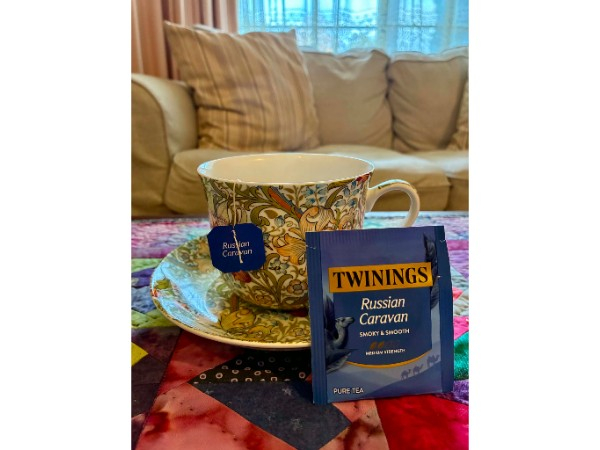
I think today might be my last Twinings day for May. If you’re interested, do a search of “the skinny Twinings shop in London”. It’s three metres wide, 18 metres long and can be located at 216 Strand. So sweet!! I saw it from a Hop On Hop Off bus ten years ago but didn’t get inside. Anyone fancy a trip to London?
Speaking of travelling, let’s take a caravan trip to Russia. Several people have mentioned Russian Caravan and Lapsang Souchong tea in various messages in recent days, and no one has had a kind word to say about either. I remember not liking Russian Caravan in the past, but we’re 18 days into this Ridiculously Good Challenge. Things may have changed.
The Twinings packet says, “This naturally smoky Chinese Keemun tea is reminiscent of tea camel caravans travelling to Russia in the 19th century. During the journey, the tea absorbed the aroma of the campfires giving it a subtle smokiness that inspired this blend’s name.” The T2 website says of its rendering, “Customers appreciate the strong, smoky flavour, describing it as rich and woody with notes reminiscent of campfires and smoked bacon”.
These descriptions, especially the old bacon notes, did not fill me with hope. I set myself up for success by serving this morning’s tea in this excellent William Morris teacup and accompanied it with hot buttered toast.
They say if you do something enough times you get good at it. Practice makes perfect. And I have been practising my tea drinking this month!
To my immense surprise I loved this cup of tea! Thankfully, no sign of bacon bits lurking in the teabag, and I detected no bacon notes in the flavour, not that I was looking for them. I liked it so much that afterwards I headed straight out to every local shop that sells tea in search of Lapsang Souchong because maybe that’s not so bad either. I couldn’t find any Lapsang anywhere and when I came home, I did some research and discovered that Twinings discontinued it in their line up a few years ago, and evidently that created quite the stir amongst the Lapsang Souchong devotees!! Instead I had a second cup of Russian Caravan this afternoon to verify my results and again, it was very enjoyable. Admittedly I had both cups in oversized teacups so there will have been more freshly boiled hot water than prescribed on the instructions.
I did say right from the beginning that there would be some controversies along the way. Meredith liking Russian Caravan tea can be added to that list!
Share
17 May – T2 Blue Mountain
Sunday 17th May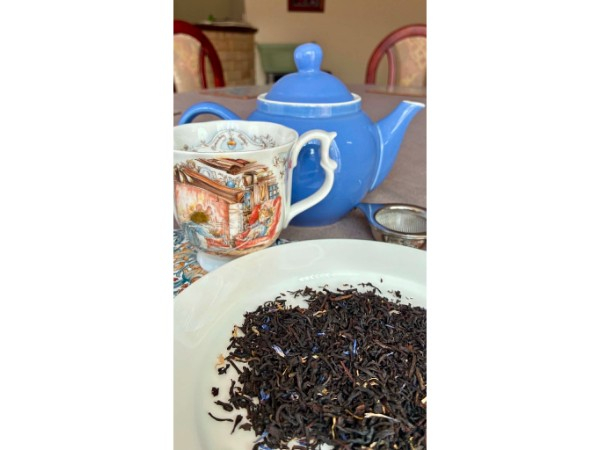
“A lighter black tea laced with notes of stewed fruit, vanilla and a lingering sweet finish.”
Ingredients: Black tea, cornflower petals, flavouring
I love this tea and now, looking at these notes, I understand why. The description and the ingredient list bring all the fruits, flowers, vanilla and black tea love together into the one place. It’s another tea that I have at home in leaf form. The tea leaves are very pretty. I do have a soft spot for cornflowers!
See the little blue teapot-for-one in the photo? We got that on our first ever holiday with our firstborn son. He was three months old and we packed the car to the gunwales with all sorts of accoutrements for babies and very little for ourselves.
When we arrived at our accommodation there was every single thing one might need for a fancy coffee of that era – plunger, coffee grounds, the old Bodum coffee cups – and then some very sad looking, very ordinary teabags. When we went to the shops to buy supplies my husband found that little blue teapot on the supermarket shelf. It was cheap as chips and it’s not that fancy (although I wouldn’t classify it as chonky – it does have a certain elegance to it) and he bought it for me with some tea leaves. I’m not all that sentimental when it comes to objects, but that little blue teapot is one of my favourite things.
Today’s cup of tea was lovely - a very nice way to pass a Sunday afternoon.
Share
16 May – Single Origin and Blended Black Tea
Saturday 16th May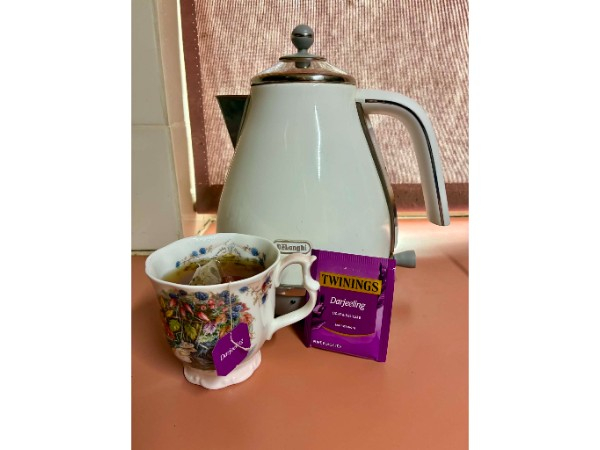
Today was a Twinings day and I moved from single origin to blended tea.
This morning I had a cup of Darjeeling tea. The package says, “Light, delicate and with natural floral notes, Darjeeling is known as the ‘champagne of teas’. Grown exclusively in the tea gardens of Darjeeling, India, a town in the Himalayas and surrounded by the highest peaks in the world, this is a special brew that is sure to impress”.
Because it was the “champagne of teas” I decided to break out the Royal Doulton Brambley Hedge porcelain beakers. I chose the Autumn beaker – appropriate to the season and also the best match for the teabag label and packaging!
Cups matter. A chonky cup doesn’t kill a cup of tea but a fine china cup certainly enhances the tea drinking experience. Back in our first year of marriage the first wave of café culture was booming, and my husband and I ate out a great deal. We were newly married, double income, no kids, no mortgage, not a care in the world. While we sampled many different places around Perth there was one place in Victoria Park that we always went back to. This Vic Park establishment became like a second home over many years. We were on first name terms with the staff and were always welcomed like family.
When we went from two incomes to one to half, then with a mortgage and then with kids our eating out turned into going out for coffee. Of course, I had tea. I rarely saw anyone else have tea. It was coffee all the way in the late ‘90s and early noughties. The tea was teapot tea, and it was served with a chonky cappuccino cup. One brave (ridiculous) day I sidled up to my friend the manager and asked what they thought about getting just a few decent cups and saucers for the tea drinkers. And they did.
At this point I feel I should say that despite appearances, I’m not a tea snob. I was asked this week what my three favourite teas are – English Breakfast, Earl Grey and mint. (The Earl has not yet made an appearance but he’s coming!) Most of my tea drinking is decaf EB from a teabag thrown into a mug, water probably not freshly drawn, mug not warmed and tea probably not brewed for the designated length of time. (Mug isn't chonky.) So please don’t be afraid to invite me over for a cup of tea. We’re having a bit of fun here…but I’m actually not that fussy!
Last week three people mentioned Twinings Australian Afternoon tea on the same day. I found some at church so that was this afternoon’s cup. On the box it says it’s “smooth and robust”. On the internet it says it “features the best of East African teas for strength, Assam teas for body and high-grown Ceylon teas for smoothness to bring you a refreshing cuppa you can enjoy every day.”
Both of today’s teas were lovely. I thought Darjeeling was a strong tea but it’s actually quite mild. It was very pleasant to drink first thing in the morning. I had the Australian Afternoon tea, appropriately, this afternoon. Like the box says, it’s a more robust tea, and like the name says, it a great afternoon tea.
Share
15 May – Two Herbal teas – or were they?
Friday 15th May
Today I tried two herbal teas.
I found a chamomile teabag at school so thought I would give it a go and test out the verity of the lawn clipping comment. Maybe I might like it now. It was a very fancy chamomile tea. A Dilmah Luxury Leaf Bag – one of those silky, pyramid bags packaged in a silver foil packet with golden yellow print on it.
Ingredients: Chamomile flowers, no additives.
The description on the back said, “Chamomile is a gentle and refreshing herb enjoyed by many as a tonic for centuries. It has a serene character and wonderful aroma. The daisy-like chamomile flower, where the subtle flavour is concentrated, has an uplifting aroma reminiscent of apples.”
Well, I didn’t get any of that. Lawn clippings may be an overreach. I certainly didn’t get the apples or the serene character. The words “hay water” were mentioned yesterday. It’s not unbearable. I had the whole cup. I felt I had to, given the grandeur of the packaging. But why would you pick this, when there is Packs a Peach to be had?
Tonight I’m having a cup of T2’s Mint Mix. I have this as loose leaf tea, so it gets brewed in a teapot. With the ingredient list of peppermint, spearmint and lemon verbena, it’s a bit more three dimensional than uni-dimensional peppermint tea. More minty notes! This is a pantry staple at my house. It’s very lovely to drink.
Interestingly, the chamomile was branded as a tea, but there were definite chamomile flower chunks in that silky pyramid bag. And I have just noticed that on the packaging of Mint Mix it is described as a tisane but there are no chunky bits in this one. It’s all leaves. So that blows my tisanes have chunks theory. There goes a week of scientific endeavour.
But lest you think I have been drinking herbal teas and tisanes all week, here is a picture of the English Breakfast tea I had on Wednesday morning. We snuck away for a little holiday this week, close enough for me to get to school but far enough away to be right near the beach. Hat tip to the ladies at the Sugar Lips Donut Co coffee van at the Silver Sands Beach car park, who on the second day remembered that I have my tea with a dash of milk and no sugar.
Share
14 May – Another Two Tisane Day – and this one was at school
Thursday 14th May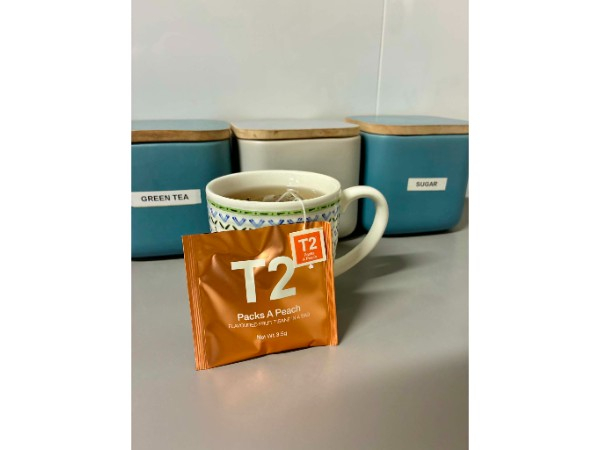
T2 Packs a Peach
This morning I had Packs a Peach during a student services team meeting. This can be had hot or cold. I had it hot. Brewed in the usual way.
Ingredients: Apple, white hibiscus, papaya cubes papaya, sugar, sweet blackberry leaves, peach 6.5%, chicory root roasted, natural and artificial flavouring, marigold petals, acidifier 330
Acidifier 330 sounds alarming. Research tells me it’s citric acid. That’s less alarming.
This was a jolly tea indeed. Fruity, like Pumping Pomegranate, but less pump and more elegance. The aroma to flavour ratio was even, which was pleasing. Five stars from me.
Tisane chunk testing: very chunky.
T2 The Quiet Mind
I thought this one sounded like a good choice for the end of a busy school day so brewed it up to have during the last hour of my working day, after the students had left and I was attending to admin.
Ingredients: Rosehip, apple, peppermint, chamomile (5%), elderberry, lemongrass, strawberry leaves, sage, lavender, silver lime flowers, Tulsi, schisandra berries, natural flavouring, eucalyptus (2%), ginseng, mallow flowers, echinacea.
That’s a hectic list for something called The Quiet Mind. I don’t even know what some of those ingredients are. Also, I have been heard to say that I don’t like chamomile tea because it tastes like lawn clippings. Ridiculous comment really, because I’ve never actually consumed lawn clippings. I guess the senses of taste and smell are close cousins.
My office buddy and I spent a long time trying to land on a description of the aroma. In the end we decided it smelled a bit like a shop that sells incense. It tasted somewhere between funky and musty, with eucalyptus undertones. I didn’t get to the bottom of the cup.
Tisane chunk testing: more leaves than chunks.
Share
13th May – A Two Tisane Day
Wednesday 13th May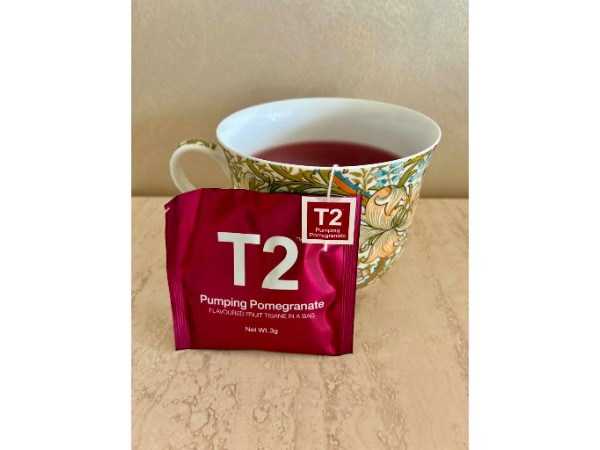
T2 Pumping Pomegranate
Ingredients: Apple, hibiscus, rosehip, elderberry, flavouring, pomegranate seed 2%.
Everybody loves Pumping Pomegranate. It’s a good hibiscus and rosehip tea. But the pops of pomegranate (and elderberry) make it pump.
As you know I grew up in a black-tea-brewed-in-the-teapot-and-served-with-milk household. If you wanted to be a bit fancy, you took your tea black and added a slice of lemon. Over time during my high school years my adding of lemon slices escalated to more and more lemon slices and juice until I bypassed the tea and just had hot lemon drinks.
When I travelled Europe with Allison in the summer holidays between third and fourth year uni, I discovered a world of teas I never knew existed. My favourite discovery was hibiscus and rosehip tea.
There was a particularly spectacular hibiscus and rosehip tea moment. We were in the Black Forest in Germany, and although we were on a pretty tight budget, we were determined to have the best black forest torte in situ that we could find. Hence we found ourselves not dressed for the occasion in a very nice restaurant with our slice each of the cake of the region, Allison with coffee and I with my newly discovered tea of choice. While travelling separately for a couple of weeks prior a fellow traveller had taught me that once you need to remove your teabag from the cup you can fish it out with a teaspoon and then wrap the string around the bag and the spoon, pull said string and squeeze out the residual liquid from the teabag into the teacup. I took this occasion to demonstrate this new skill to Allison. The string broke, the spoon jerked and collide with the cup and the cup emptied all over the white tablecloth and somewhat over my piece of cake. Core memory.
But not scarred. Pumping pomegranate is a fun drink. It smells and tastes delicious. It feels like a warm Vitamin C hug. Probably not an ounce of Vit C in there given the teabag had 100-degree water thrown all over it, but I’m not letting that get in the way of a good story! I had it hot, but it works just as well as an iced and/or spritzed tea.
Tisane chunk testing – all chunky.
T2 tisane – The Dreamer
This evening I tried another caffeine free T2 tisane – The Dreamer. Last week I had caffeine on a school night and that didn’t end well.
Ingredients: Rosehip, lemon balm, lemon verbena, rose petals, orange peel, sunflower petals, calendula petals, hops, valerian, cornflower petals, flavouring.
That is a very pretty list of ingredients. When the hot water hit the teabag I caught a flash of cornflower blue. That was pretty amazing.
The Dreamer is a mild tea, which is good for an evening beverage. Like lots of herbal teas I’ve had the past, the aroma was more prominent than the flavour, so it was hard to pick out what was going on taste-wise. The lemon was probably the most prominent flavour. It was a pleasant warm cup but I probably won’t buy a box of them.
Tisane chunk testing – more leaves than chunks. But a few small chunks.
Share
12th May – T2 Blue Raspberry Ripple
Tuesday 12th May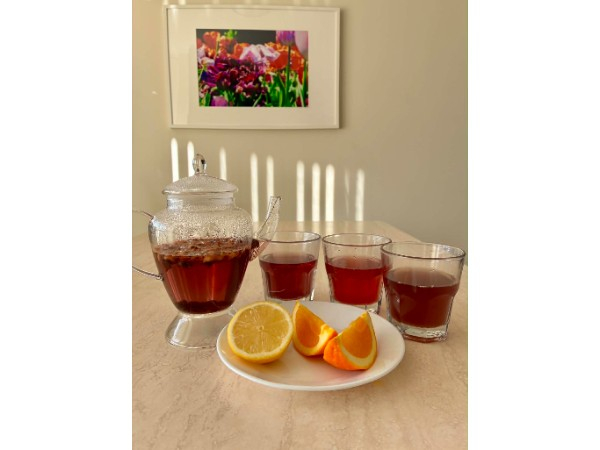
Why am I doing these tea reviews? Because they are my contribution to YouthCARE’s Ridiculously Good Challenge. YouthCARE is the organisation that puts chaplains into schools, and the overall purpose of the Ridiculously Good Challenge is to both raise awareness of the good work that YouthCARE does in schools, and also to raise some funds to keep this good work growing and flourishing. If you would like to make a tax-deductible donation to the good work of YouthCARE please follow the link or press the button, depending on where you are reading this.
So today, a special treat! Blue Raspberry Ripple from T2. This was a birthday present from Jane back in January. I'm not sure why it has taken me this long to get into it! Clearly saved for this special occasion!!
Ingredients: Apple, raisins, elderberries, raspberries, blue butterfly pea flowers, flavouring, blueberries.
It’s labelled as a tisane, and in testing the “Are tisanes chunky?” theory, this one is definitely chunky. There’s absolutely nothing that resembles a leaf in the raw material.
Instructions: The usual – fresh, boiling water and let it brew for three to five minutes.
Plot twist: The blurb on the tin says, “For a moment of magic, add a squeeze of citrus and watch how this blue brew changes colour”.
Aroma: Very berry. Berry delicious.
On its own: The flavour was surprisingly mild, and that was after observing the upper end of the brewing time.
With a squeeze of lemon: Given the exciting instructions I’m fairly certain I was expecting an astonishing change in colour from blueberry blue to raspberry red. All that really happened is that the lemon lightened the colour, as it is does with black tea. The addition of the lemon however added a really excellent zing to the flavour. This version was very satisfying. I imagine this version would be very nice had cold with some soda water for fizz and served in a big glass of ice with a slice of lemon for presentation.
With a squeeze of orange: This didn’t change the colour especially – just made it go slightly murky – and it didn’t enhance the flavour particularly.
I think it would be nice with a squeeze of lime, but there were no limes on hand today.
Photo: Left to right – on its own, with lemon, with orange. The tin it came in is a very satisfying blue colour, but it didn’t make the photo because it was playing tricks with the colours in the glasses.
Share
11th May – Post Conference Tea Part Two – Bengal Spice
Monday 11th May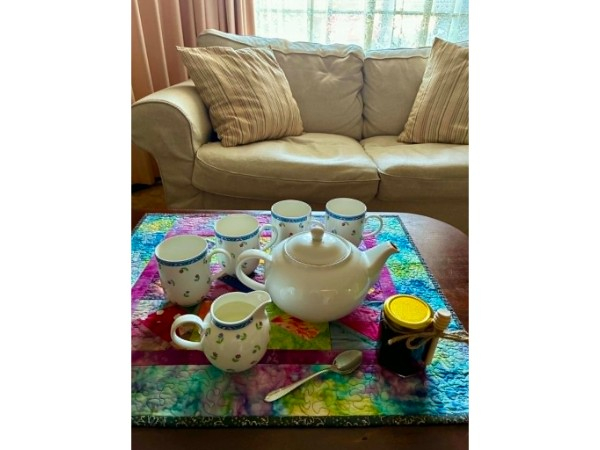
When is a tea not a tea? When it’s a herbal tea or a tisane.
I did some looking into this. Tea is the beverage that is made from the Camellia sinensis plant. The key thing about herbal teas and tisanes is that they don’t have the leaves from our tea plant. Instead, they are concoctions of myriad combinations of herbs, spices, flowers, fruits or other plant material including bark and roots. And they are caffeine free. This means that technically speaking, rooibos isn’t tea. But the reading I have been doing suggests that tea people generally seem okay with the herbal tea folk using their word, so herbal tea and rooibos tea it is. Tea fellowship.
I was trying to find out the difference between a herbal tea and a tisane. I read one lofty looking article that insisted that herbal teas and tisanes were very different. To my mind though their description seemed to be saying the same thing but using different words. The key difference does appear to be in the brewing – that herbal teas are steeped in hot water like black tea but tisanes can be steeped, simmered or boiled depending on the ingredients. And perhaps the herbals teas are mainly leaves while the tisanes have the chunky bits. I’ll explore that theory in the days ahead because for the next few days, we’re entering our tisane/herbal tea era.
The first herbal tea is Bengal Spice from the Celestial Seasonings range. Far be it from me to judge a book by its cover, but left to my own devices, I would walk right past this box on the supermarket shelves. This is why we need these recommendations to expand our horizons.
This is a post-conference tea because I heard the lovely Amy, unbeknownst to her, talk about this tea on a podcast last week and then the very next day she recommended it to me via this Ridiculously Good challenge. It was a sign! Amy was at the conference, and she kindly brought some Bengal Spice with her.
The box says that Bengal Spice is a “robust” blend of cinnamon, roasted chicory, roasted carob, ginger, cardamom, black pepper, cloves, vanilla and nutmeg, often best served with milk and honey. I’ve also read that this brew is sometimes described as “chai-like”, but it’s not a chai. More on that later.
But this is a slightly scary brew for me. To my mind that’s quite a hectic ingredient list. But I trust Amy, and after all, this whole thing is the Ridiculously Good CHALLENGE. So here goes.
Aroma when the freshly boiled water (instructions said freshly boiled “filtered” water – but that is a step too far!) hits the tea bags – beautiful.
Taken black – Very nice
Taken black with honey –I liked it. A lot. I surprised myself. Not too much honey though. Just the merest suggestion.
Taken with milk – Not to my taste
Taken with milk and honey – Very not to my taste
This would be a great tea to have when you have a big session of studying or writing at the computer ahead of you and you need a pot of tea sitting beside you. It would also be an outstanding brew to have if you had a cold. I have some integrity in that department because I had a cold a few weeks ago and I’m still suffering from the after effects. When you have finished drinking this tea it leaves a nice, warming feeling on your palate and in your chest and tummy. For a slightly scary, hectic tea I was pleasantly surprised. Look out for the tiger on the box on your local supermarket shelves.
Share
10th May – Post Conference Tea Part One – T2 New York Breakfast
Sunday 10th May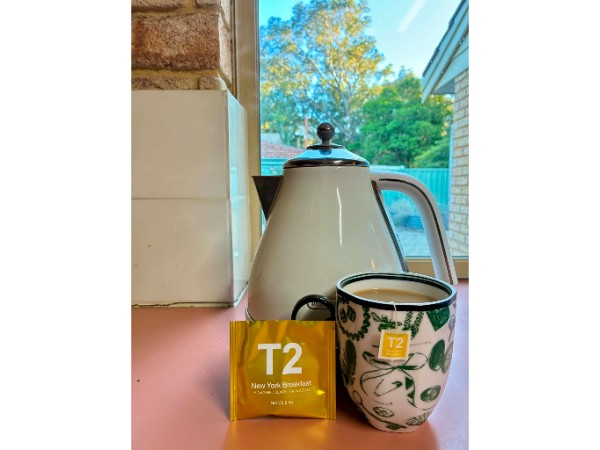
Back on the 3rd May when I was drinking Fortnum & Mason Black Tea with Vanilla and comparing it with T2 Melbourne Breakfast, a couple of friends commented that they loved T2 New York Breakfast. I may or may not have asked one of those friends, who I knew was going to be at the conference, to bring a sample from her stash. Shelley delivered, with a whole box, and Tracey had a single sachet in her box of treats curated from her pantry.
When I read the blurb about this brew on the website it said,
“A full-bodied black tea boasting the taste of hot pancakes, inspired by a perfect New York moment.”
I got a tiny bit scared (as scared as one can be of a teabag) because, as keen readers will have noted, I don’t put sugar in my tea. When teas start sounding sweet, I get a bit concerned.
This descriptions was followed up with, “Black tea with notes of vanilla, cinnamon and maple syrup.”
Sounding more possible, but contingent on the quantities of maple syrup.
The list of ingredients read, “Black tea, cinnamon, flavouring, vanilla.” And then I understood the initial recommendations, riffing off the original vanilla teas.
New York Breakfast. First and foremost, it’s a very good black tea, and I had it with a dash of milk. No Sugar. The power of suggestion is a thing so if I put my mind to it, I could pick up the hint of hot pancakes. If I didn’t put my mind to it, I was getting a very mild Christmas-y vibe. I guess that was the cinnamon and also the vanilla which was slightly milder than the Melbourne Breakfast. This is a great tea. I will be adding it to my burgeoning list of nice teas to drink. Anyone want a cup of tea? I have MANY to choose from!
Interestingly, when I was answering the lunchtime question about my favourite flavour of ice cream, I mentioned the strawberry just to be a bit interesting, but I did add that these days my preference is plain old vanilla. The students were happy enough with that answer. A couple even said that vanilla was their favourite as well, perhaps because it really was or perhaps because the kids at my school are very kind and maybe they were just trying to make me feel better about my ordinary answer, because that’s how we roll at my school.
And I was very happy this morning that the packing of the New York Breakfast tea matched the morning light on the tops of the trees outside our kitchen window.
Share
9th May – Conference Tea
Saturday 9th May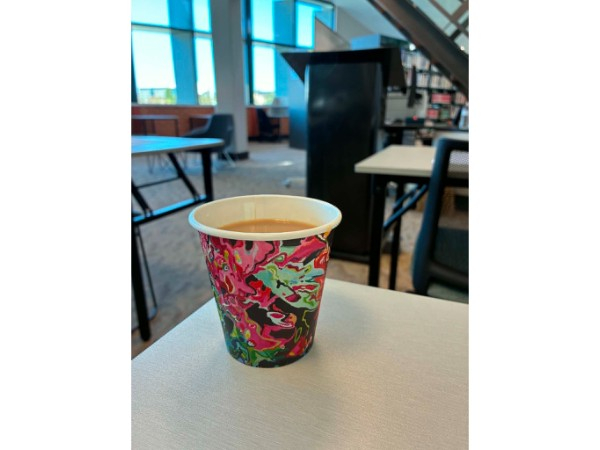
I was at a conference today.
There are lots of variables that can have an impact on conference tea.
· Choice of teas – it can be narrow and it can be broad. One conference I went to the tea selection was so vast I couldn’t actually find the EB!
· Temperature of the water. Those urns take a long time to heat up and a hot cup of tea, especially at the beginning of a conference is a very precious gift, because it means that someone got there REALLY EARLY to fill the urn and turn it on.
· Sometimes the milk can be problematic. I’m looking at you, long life milk!
· The cup. Some conferences encourage attendees to bring a travel cup. I have a very nice stainless steel keep cup that keeps cold drinks super cold in the summer, but it makes the tea taste funny, and I have a glass one but I don’t like the taste of tea through the rubber lid. I know. Fussy fussy! Naughtily I usually rely on the cups provided. I haven’t seen a Styrofoam cup in a long time, and that is a good thing. But the cardboard cups. Some of them are great. Ridiculously, if they have a great design then they are just fun to drink from, and that can almost cancel out any other conference tea issues.
Today’s tea at the conference:
· An excellent choice of teas, clearly labelled. Something there for everyone.
· The water was hot. Thank you kind conference people.
· Two choices of milk – full cream and hilo. My mum maintained that coffee was best served with full cream and tea with hilo, so that’s how it is.
· Funky cup. Very happy.
· Tea of choice – Tetley. So funny.
· Bonus points for the second cup, made with love for me by Eleanor.
And thank you to Amy, Shelley, Tracey and Leni (bit of a rhyming thing happening here) for slipping various tea samples into my hands during the day. Warm tea fellowship. Good times.
Share
8th May – F&M Black Tea with Strawberry
Friday 8th May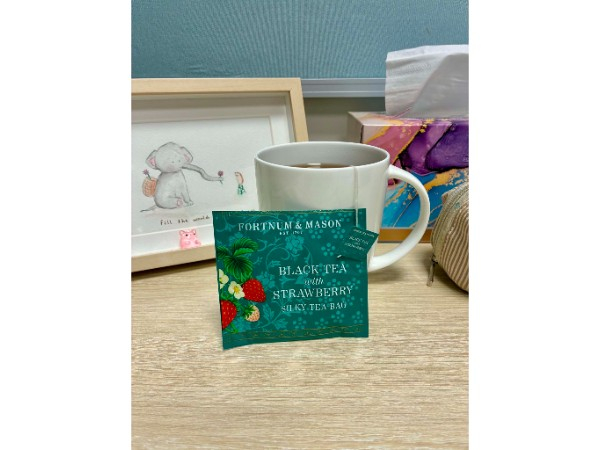
Today I finished my two days of chaplaincy for the week. A highlight this week was a letter in my chaplain’s letterbox, addressed to “meredef” – that’s a new one for me and I love it! – about the little problem this student was having with her “frens”. Another highlight was a conversation I had with a Year Six student about the recent camp. When asked what he loved best about the camp, he said, “Seeing his friends and also the teachers in a different way, in a different light.” I almost wept. What an answer.
Yesterday at lunchtime I was asked what my favourite ice cream was by a group of students. I told them that when I was at school one of my favourites was strawberry.
In honour of strawberry flavoured ice cream and also in celebration and heartfelt thanks for all your kind donations so early on in the challenge to see the work of YouthCARE grow, I pulled out another Fortnum & Mason’s treat from Polly’s stash – Black Tea with Strawberry – and I took it to school and had it there.
The Fortnum & Mason website says,
“An ever-so-English blend of bold black tea and naturally sweet strawberry pieces… Heat freshly drawn water to 100°C, brew for 1-3 minutes. Best served without milk.”
It was, of course, lovely. I had it without milk, as per instructions. You taste the tea first – robust but not overpoweringly strong – and then the strawberry taste follows. That’s the flavour that lingers on the palate. It was a very elegant cup of tea.
I didn’t get quite to the bottom of the cup before I had to leave my desk to run a workshop on resilience, and when I returned the office smelled deliciously of strawberries. The gift that keeps on giving. Also I managed to not break the silky tea bag this time. Winning all round.
Share
7th May – English Breakfast Tea – Teapot vs Teabag
Thursday 7th May
I grew up in a house of tea drinkers. And it was loose leaf tea in a teapot every time. Here’s how my parents taught me to make teapot tea.
1. Put fresh water in your kettle and bring it to the boil.
2. Just before the water boils take a little of the hot water from the kettle to warm your pot and your cup.
3. Empty the now warmed pot and add the required amount of leaf tea. (The tea caddy was cream with a green lid – it would be classified as “vintage” these days – and the dedicated measuring teaspoon that stayed in the caddy was red.)
4. Once the kettle has boiled take the teapot to the kettle, not the kettle to the teapot, and pour in the required amount of boiling water.
5. Let the tea brew by itself. No stirring with a spoon or jiggling the teapot. This is up for debate, but in my house the tea was (supposedly) left to itself to brew. I say supposedly because I confess that in my younger years, I would occasionally give the tea a bit of a help along to speed up the process with some jiggling of the pot (but never stirring with a spoon) because I thought all that was required was getting the tea to the right colour. I didn’t know about the finer details of brewing for flavour.
6. If it is a cold day put a tea cosy on the teapot to keep the tea cosy while it is brewing.
7. Once the brew is ready, if you are taking your tea with milk, add the milk first, and using a tea strainer, pour the tea into the cup.
8. Deliver the cup of tea to its lucky recipient, without spilling any of it in the saucer.
So, is teapot tea really superior to teabag tea?
Two identical, warmed cups. Twinings loose leaf EB tea, made according to the above instructions and brewed for the time suggested on the pack. Twinings EB teabag, made in the warmed cup with fresh boiling water and brewed for the time suggested on the pack. Milk in first for the teapot tea. Milk in last for the teabag tea – because if you put the milk in first with teabag tea this will reduce the heat of the boiling water and then the tea won’t brew properly. No sugar added.
The verdict: it didn’t take three quarters of each cup to work this one out. I knew after one mouthful of each, and one more just to be sure. Teapot all the way. Of course.
Share
6th May - English Breakfast Tea - Caffeinated vs Decaf
Wednesday 6th May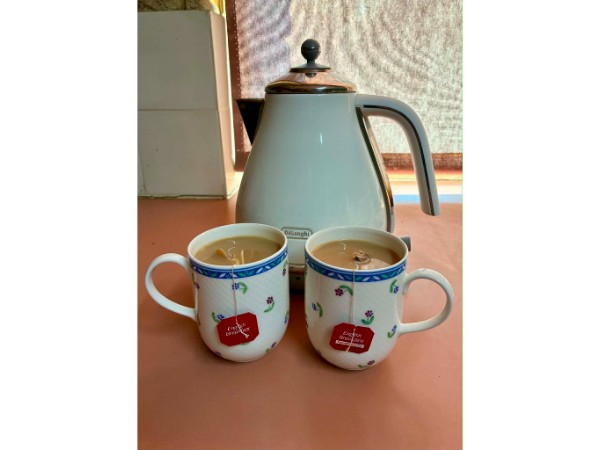
While all English Breakfast is black tea, not all black tea is English Breakfast. Black teas can be single origin so Darjeeling tea, for example, is single origin tea because it’s grown in the Darjeeling district of West Bengal in India. English Breakfast is a blended tea using tea leaves sourced from India, Sri Lanka, and Kenya. Chinese black tea is also used sometimes, though only in the fancier renderings of EB.
“English Breakfast is a strong tea designed for mornings, robust enough to be taken with milk and sugar, and usually in association with a hearty full English breakfast.” So says the interwebs. I drink it all through the day myself and into the evening, and I rarely eat a hearty, full English breakfast.
Now, I did say at the beginning that this might get somewhat controversial in parts and today is one of those days. Today I want to know, is there a difference in the taste between caffeinated and decaf EB tea? I know. But one must sleep.
So, two identical, warmed cups. Twinings English Breakfast tea in teabag form – one with caffeine, one that is decaf. Same amount of fresh boiling water, same number of jiggles, same length of brewing time, same amount of milk. No sugar added.
The results? I went back and forth and drank my way through three quarters of both cups. It was truly hard to pick. There’s a slight difference. The decaf was slightly weaker and ever so slightly less complex in flavour. So, for a post-dinner cup of English Breakfast tea (breakfast for dinner anyone??), if you favour Twinings, you can go ahead and have that cup of decaf EB tea with confidence.
Share
5th May - Dome Tea - Orange Pekoe
Tuesday 5th May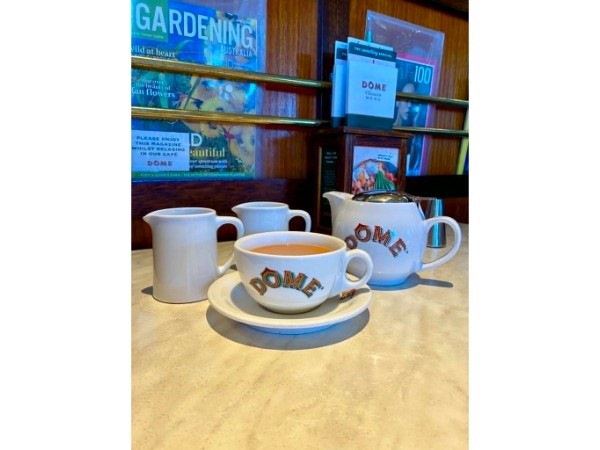
I know there are mixed opinions about the Dome, but I love them because both our boys cut their teeth in the world of work at our local Dome cafes. They were well treated, learned lots of amazing skills and I can’t say better than that.
I can’t speak for the coffee because I don’t drink it. But I can speak for the tea. Dome uses loose leaf tea. That is a bit of a rarity, so props to them. I’m not fond of really strong tea (I’m learning that I may be in the minority here) and I find that they’re generally a bit heavy handed with the tea leaves, but this is very easily remedied by asking for extra hot water as well as milk on the side. This also means you can get three Dome cups of tea out of a pot!
I had a meeting at the Dome today and my tea of choice was Orange Pekoe. A deliberate choice because we need to learn about Orange Pekoe. It’s a tricky tea right from the get-go because it isn’t orange in colour nor does it taste of oranges. It’s a black tea from our old friend, the Camellia sinensis plant. There are various theories, but it seems that the “pekoe” aspect refers to the grade of the tea – this tea uses only the top couple of leaves and the bud of the tea plant and is generally picked early in the harvest – so it’s quite special. As for the orange, there’s a suggestion that these special handpicked uppermost leaves were presented as a tea by the Dutch East India Company to the Dutch royal family – the House of Orange – in the 1600’s. Orange Pekoe.
Today’s brew was quite strong, probably because I was talking too much and it brewed for too long, but the milk and the hot water saved the day. It’s a dependable black tea, and you can trick your friends by ordering it, adding a dash of milk and then watching them wonder why you are putting milk into orange tea, and then wondering why the milk isn’t curdling. But now you know – there’s no citrus here!
Share
4th May - The Tea Ladies - Part Three - and Rooibos Tea
Monday 4th May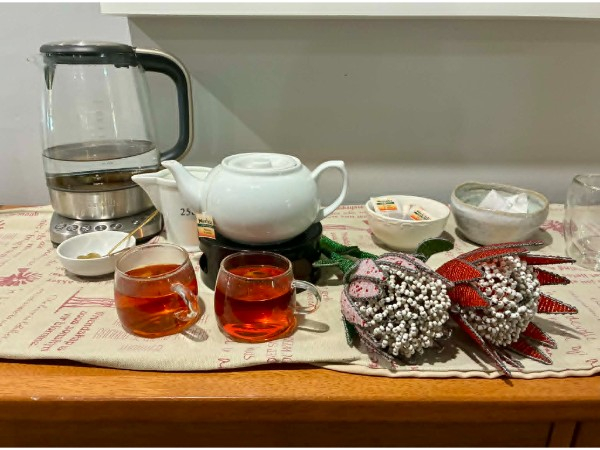
There is a fourth feature of The Tea Ladies. At least, this is a feature of my particular ensemble of Tea Ladies. We meet, we drink tea and we pray. So many cups of tea consumed. More than I could ever count. And so many prayers shared and prayed.
Liesl is another friend in my Tea Ladies ensemble. She lives in the same suburb, our kids went to school together, we both taught Scripture in the local school and now we are both chaplains. We meet on Monday mornings three or four times per term, drink tea, share about our lives and our work, and we pray. Today I met with Liesl to drink tea from her origins of South Africa – Rooibos tea.
White, green, oolong and black tea all come from the same plant - the Camellia sinensis plant. Rooibos tea comes from the red coloured, needle-like leaves of the Aspalathus linearis plant, which grows exclusively in the Cederberg mountains of South Africa, a region that is both very hot in the summer and very, snowy cold in the winter. The tea is a distinctively red colour and bonus! – it’s caffeine free.
And it’s a tea I have never, ever tried before.
Dear Liesl had the stage set with kettle (with fresh and not previously boiled water), glass cups so that we could admire the distinctively red colour, milk, sugar, lemon, proteas, South African themed drink coasters on which to rest our cups and two different types of rooibos to try.
We started with the OG, standard Rooibos – slightly fruity, slightly smoky, not overpowering and very enjoyable to drink with or without milk (I tried both ways but probably preferred the no milk option the best) – and then we moved onto Rooibos with Vanilla. The vanilla worked. It added an extra note without overtaking the clean, pleasant flavour of the natural tea. Rooibos is officially being added to the repertoire.
Speaking of chaplains, please consider making a donation to YouthCARE if you are able, to support the ongoing work of chaplains in schools. You are absolutely totally free to just keep reading The Tea Diaries and I am very happy with this, but none the less, this is a fundraising campaign, so just once a week I am going to remind you that you can find my fundraising page by clicking on the link below.
Share
3rd May - The Tea Ladies - Part Two
Sunday 3rd May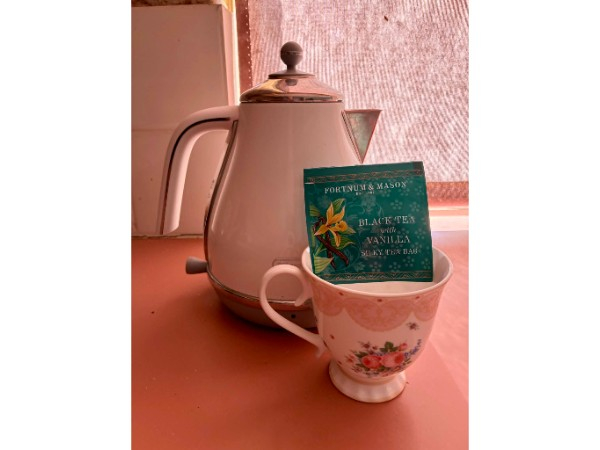
There are four things that stand out about The Tea Ladies. One is that they will generally (or always) choose tea over coffee.
A second feature is that birthday and Christmas gifts to and from The Tea Ladies invariably involves tea – tea leaves, fancy teabags, teapots, teacups, tea Advent calendars. Not many years will go by without the giving or receiving of a tea gift.
A third feature is that when you visit their house and the kettle is put on, you are offered a variety of teas.
Polly was a co-conspirator of the “Let’s go out for a cup of tea” movement. And Polly has a vast collection of tea – more vast than I realised! Last weekend I went to visit her to do a raid on her stash in preparation for this Ridiculously Good Challenge. I came away with an abundance of individually sealed teabags of widely varying provenance and two other boxes of tea. That’s besides the three boxes of teas slipped into my bag the previous time I visited and the tea I received from her for my birthday in January. Too much? No. Beautiful, kind and generous to a tee. And it will all be used in time.
Today we caught up over a video call and drank tea together. For the occasion I chose one of her amazing teabags – the Fortnum & Mason Black Tea with Vanilla. The packaging says, “For best results heat freshly drawn water to 100 degrees C. Use one teabag per person and brew for 1 to 3 minutes. Best served without milk.” I liked the comment about the freshly drawn water. Tea tastes different if you reboil the water in the kettle. Use fresh water folks!
I quite like to start my Sundays with a T2 Melbourne Breakfast which is black tea with vanilla, best served with a dash of milk. I was ready to ignore F&M’s instructions regards the milk but they were right. No milk needed. The T2 version is black tea and vanilla. You can pick up both the flavours. This afternoon’s F&M was blackteandvanilla. One full flavour, rounded, elegant, refreshing. Fortnum & Mason really know how to do a good tea. I managed to split the silky teabag, so the brewing and subsequent straining process was a bit of a palava. Note to self…go easy with those F&M teabags.
There is another story to tell about Fortnum & Mason tea, but I will save that for another day.
Share
2nd May - Tea Ladies and Silk Oolong
Saturday 2nd May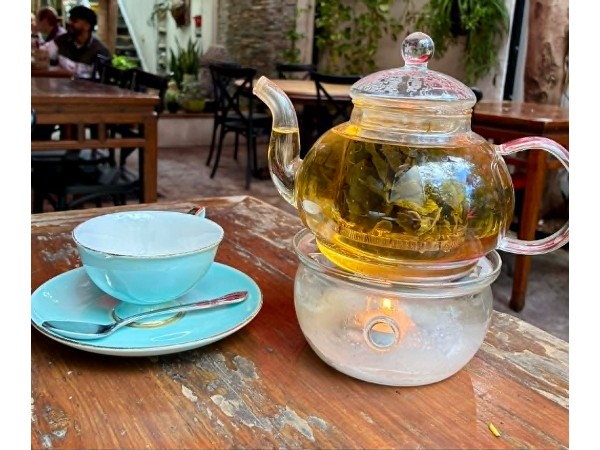
Back in the ‘90s I had a fabulous group of friends, who remain dear friends to this day, and we would often go out for a coffee together. Except two or three of us always had tea. My tea drinking friends and I discussed this “going out for a coffee” business and we conspired to introduce some counter-cultural terminology. Over time and by stealth we reprogrammed the coffee drinkers, and our group’s catch-ups over steaming hot beverages were arranged by tea and coffee drinkers alike with the words, “Let’s go out for a cup of tea!”
Today I caught up with one of the tea ladies. Jane and I met at Chapels on Whatley – a fantastic tea house in Maylands. We had two different pots of tea but the tea du jour was called Silk Oolong.
Let me tell you what I have learned about Oolong tea. It’s a traditional Chinese tea made from the same plant used for white, green, and black teas. White tea is simply plucked and dried, minimizing oxidation. Green tea is heated (steamed or pan-fried) soon after picking to reduce oxidation. Black tea is fully oxidised for a bigger flavour, its black colour and more caffeine.
Oolong is partially oxidised and bridges the gap between green and black tea – and oxidisation can be anywhere between 10 and 80%, which seems like quite a big window to me. The leaves are often long and twisted – today’s Oolong looked a bit seaweed-like in the pot.
But it didn’t taste like seaweed water at all. According to the menu, it’s described as “a sweet, crisp brew”. It’s not a strong tea as such, but the flavour was indeed sweet and crisp, pleasant and refreshing. And it was silky smooth. They gave it exactly the right name. It was a delight to drink, and I would choose this one again.
Share
1st May - Kitchen Basics
Friday 1st May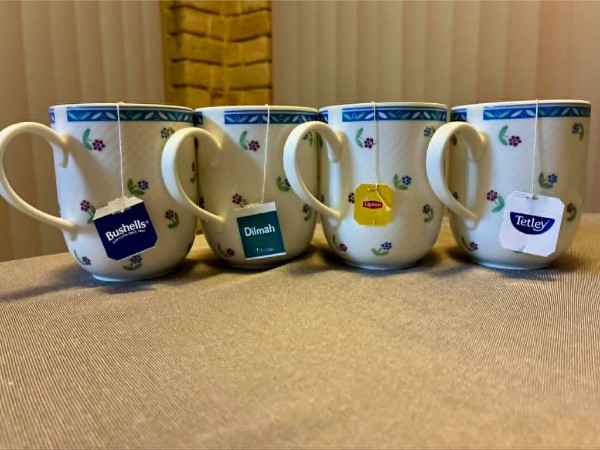
Four identical, warmed cups. Four brands of standard kitchen-essential black tea. Same amount of boiling water, same number of jiggles, same length of brewing time, same amount of milk. No sugar added.
It’s been a bit of a day, so I could have probably finished off all four cups, but given the time of the evening that wouldn’t be wise. So I tried each tea once and made my not very extensive notes, and then did a second and third taste test to make sure I wasn’t mistaken. The result surprised me, and then I did a bit of research which verified my results. In alphabetical order:
Bushells – not much flavour
Dilmah – lovely
Liptons – not much flavour
Tetley – really lovely
Dilmah has always been a great staple tea. I don’t think I have ever purchased Tetley tea, although it is the tea of choice at school – purchased by a lovely English tea-loving staff member. It turns out that Bushells is owned by Liptons. Same tea, and not much flavour, based on this evening’s trial. Dilmah is a Sri Lankan family-owned operation – Ceylon tea direct from the source. Tetley is a British tea company. I had some of the best tea ever when we were in England. They know how to make a good cup of tea.
And so I finished the cup of Tetley tea, and I may be changing my tea purchasing habits, once I have cleared the backlog created by this May venture!
Share
Let the games begin!
Thursday 30th AprIt starts tomorrow. The tea drinking and the reviews. Things you need to know:
1. I will drink a cup of tea every day in May and write a review.
2. For the most part the reviews will be about the tea that I drink, although occasionally I may review some aspect of tea making or tea drinking.
3. It will be completely subjective, totally lacking in rigour and prone to bias.
4. It is a truth universally acknowledged that tea made with loose leaf tea in a warmed teapot will always eclipse teabag tea. Be that as it may, so that I don’t end up with 31 boxes of loose leaf tea in my pantry at the end of this Ridiculously Good month of tea drinking, most of the teas reviewed will be teabag tea. Many of them have been donated to me by dear tea drinking friends.
5. If you have willingness and capacity, please donate to the good work of YouthCARE via my fundraising page. It’s fully tax deductible.
Did you spot the Jane Austen reference???
Share
What am I RIDICULOUSLY GOOD at? The answer is ridiculous!
Tuesday 28th AprWe were asked to consider something we are ridiculously good at. So, what am I good at? My immediate thought was DRINKING TEA!! And then I thought, I could drink 31 one different teas and write a daily review, because I am quite good at writing reviews as well.
Other thoughts? I could write letters - a letter a day. I have been trying to get into watercolour painting (I’m at pre-primary entry level) so 31 paintings, or reignite my calligraphy skills and copy out a Bible verse a day in some amazing script. Take 31 interesting photos?
There are other numbers to play with, besides 31. There are 450 chaplains - so I could write down 450 things I am grateful for during May. That's actually achievable at 14.5 things to be thankful for per day. There are 600 schools who are blessed by the chaplaincy service - so if I walked for 19.35 minutes every day that would total 600 minutes by the end of the month. Or clock up 600 minutes of reading in the month. There are eight chaplains in my Pastoral Support Group - I could do something eight times in the month to honour each of my chaplains.
I put the dilemma of this decision out to my friends on social media, including asking for other ideas from that brains trust.
Well, I am here to tell you that there was an avalanche of support for drinking tea! Hilarious!! So I will be drinking a cup of tea every day during the month of May and writing a review. I hope you will come along for the ride. It starts on Friday and it’s going to be fun, and slightly ridiculous. Please consider making a donation to this endeavour.
ShareThank you to my Sponsors

$581.63
Jenny Sexton
$540
Grateful Friends
$500
Anonymous
Keep up the good work Meredith!
$311.70
Anonymous
$169.65
Liesl
We thank God for you Meredith! You are the most amazing tea-lady, friend, chaplain, listener, encourager and lover of God’s word.
$168.02
Sue Brien
Thank you for providing such a fascinating and informative 31 days of tea! I’m loving every word, photo and anecdote so far and know it can only get better! ☕️😋 I’m “ridiculously” enthusiastic about needing the complete “31 days” published in hard copy for purchase…..more funds for the Youthcare cause-and such refreshing entertainment for us tea drinkers! 🙏🥰
$162
Anonymous
$106.12
Fellow Tea Lover 🫖
From one tea drinker to another, what a great challenge Meredith for a wonderful cause! I'll be thinking of you as I drink my own cup.😄Love Robyn
$106.12
Alfinda
Love the work that YouthCare does. Keep up the good work! God bless you.
$106.12
Jean Sexton
$106.12
Claire Weatherill
Keep calm and drink tea
$100
Susan
$87
Wlps All Stars
$80.96
Anonymous
Looking forward to reading the rest of your discoveries!
$54.84
Jan Booker
On ya Meredith, very happy to help a good cause:😀
$54.84
Amy
Look forward to hearing your tea verdicts!
$54.84
Anonymous
This has been a wonderful idea - thanks for sharing it all with us.
$54.84
Lj Mcm
Great month Meredith Thank you Hugs!
$54.84
Jennie Dawson
Thank you Meredith for all you do for our school! You are a true gem 💎
$54.84
Stephanie Rogerson
What a wonderful cause to support. Much love to you and happy tea drinking😊
$54.84
Cheryl O
Well done Meredith!
$54.84
Jane
Love sharing tea with you my friend and I’m loving your posts! Jx
$54.84
Lynne Coe
A perfect pairing for you Meredith; tea drinking and good work.
$54.84
Rose And Pete
$54.84
Tracey Houghton
You're doing great in your tea reviews Meredith and we are happy to support you and YouthCare.
$54.84
Kim Saw
Have a cup for me.
$54.84
Lisa Tucker
$50
Mp
$50
Harry And Heather Mithen
$50
Catriona Woodall
$30.61
Bec
$28.43
Anonymous
Thank you for inspiring and renewing my tea drinking practices, M! Ben says he can no longer make me a cup of tea haha! Happy to support our young people holistically through Youthcare, too!
$28.43
Bobbie Oliver
Fascinating reading, Meredith. My preferred brew is Twinings Australian Afternoon Tea (when I'm not drinking coffee, of course).
$27.83
Munea
Your tea reviews are pure joy to read! Highly recommend adding a splash of milk to chamomile and honestly, green tea with milk is surprisingly amazing too.
$25
Anonymous
$25
Karen Hanna
$21.16
Martha Mcmanus
Even closer
$11.80
Judith
You are ridiculously good at so many things Meredith, but I love your speciality😂❤️. Good luck xx
$11.56
Tammara Mckeown
Keep up the Beau-TEA-ful work!!


I have really enjoyed the tea journey Jean has been sharing with me. Today we discovered why you have been on this journey, and we are privileged to help. Well done Meredith!